From intelligence to execution: three shifts shaping the future of logistics
Paul Mohan, Chief Executive Officer, Continental Europe | November 04, 2026
The next phase of artificial intelligence will not be defined by better answers alone, but by better decisions – connected across people, systems and physical operations. In logistics, that shift has the potential to change how supply chains anticipate disruption, coordinate activity and respond to customer needs.
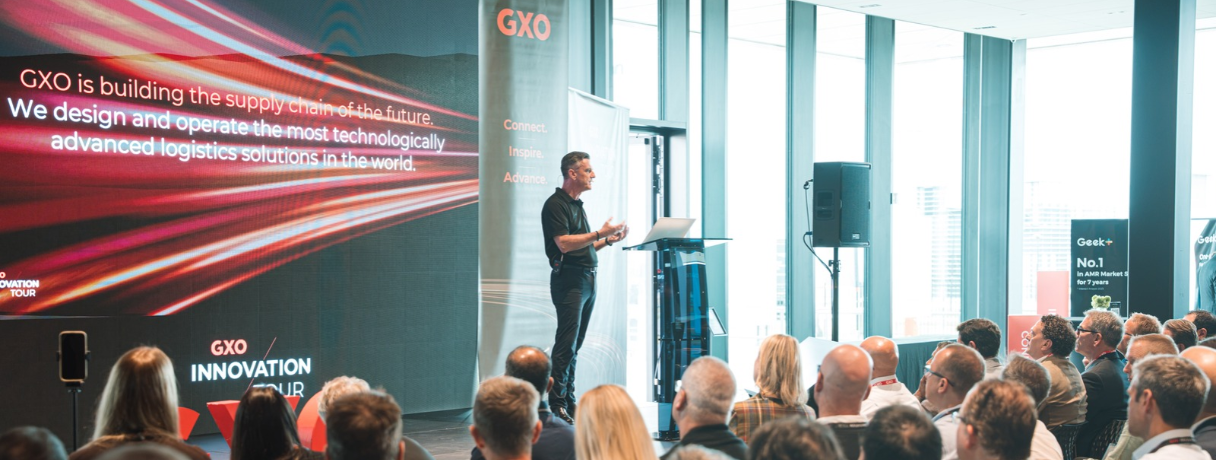
Recent conversations with more than 200 customers, partners, suppliers and experts at our GXO Innovation Tour reinforced a question I believe every supply chain leader should be considering: what happens when intelligence moves beyond individual applications and begins to connect decisions across entire operations? Three shifts stood out to me – and each has important implications for the future of logistics.
From isolated answers to coordinated decisions
The first shift is from standalone AI tools to intelligent agents that can work together. Most applications today are designed to answer a question or optimize a specific task. The next generation will be able to draw on different sources, assess interdependencies and coordinate actions toward a shared objective. I believe this shift from isolated intelligence to coordinated decision-making will be one of the most significant developments in logistics.
Consider a sudden change in customer demand. One agent could assess the order profile, another could evaluate inventory availability, a third could review labor and equipment capacity and a fourth could analyze transport constraints. Instead of producing separate recommendations, they could evaluate the trade-offs together and help operational teams identify the best response.
AI already supports decisions across logistics, from forecasting and replenishment to inventory positioning and pick-path planning. Connecting those capabilities could enable faster, better-informed decisions across more complex workflows. For customers, the value is practical: greater responsiveness, stronger resilience and more reliable service when conditions change.
To bring this to life, we developed GXO IQ, our AI-native operating system for logistics. Built on more than 20 years of operational expertise and designed to work with any warehouse management system, it orchestrates millions of decisions and workflow actions in real time. In orchestrated warehouses, it has the potential to deliver productivity improvements of 5% to 17%, and we plan to extend its orchestration capabilities to more than 50 sites this year.
Bringing intelligence closer to physical execution
The second shift is the closer connection between software intelligence and physical operations. Automation has transformed warehouses, but many machines still execute predefined tasks within fixed parameters. As AI advances, equipment will become better at interpreting its environment, adapting within clear boundaries and coordinating with other systems.
In logistics, I see intelligence moving closer to the point of execution. Inventory data, warehouse management systems and equipment already inform operational decisions. The next step is more dynamic coordination: machines and systems sharing information, adjusting tasks as conditions evolve and helping people keep goods moving safely and efficiently.
We are already seeing the results. At a fashion fulfillment operation in Venlo, more than 100 robots bring inventory to operators, supporting around 2,200 order lines per hour while reducing walking and improving ergonomics. In Poland, an automated loading system can load a full trailer in approximately two minutes, improving throughput, safety and consistency.
The opportunity is not autonomy for its own sake. It is to connect intelligence with execution so teams can manage complexity, improve productivity and respond faster to customer priorities. The strongest solutions will combine the speed of technology with human judgment – underpinned by reliable data, clear governance and accountability.
Building an organization ready to learn and adapt
The third shift is organizational. Technology can advance quickly; organizations often take longer to adapt their structures, skills and ways of working. The real differentiator will therefore not be access to AI alone, but the ability to translate it into better outcomes at scale.
Being AI-first does not mean putting technology first. It means equipping people and operations to use intelligence with purpose. That requires helping teams understand how their work may evolve, creating room for responsible experimentation and building confidence through continuous learning.
It also requires an ecosystem mindset. No organization needs to build every capability in-house. At GXO, we bring together technology, logistics expertise and external perspectives around a clear customer outcome, test solutions in live operations and scale what demonstrates value. Our partnership with Google Cloud helps us accelerate innovation and unlock the value of data and AI, while pilots such as the humanoid robots we are testing for repetitive picking tasks allow us to assess potential, limitations and safety requirements before any wider deployment. That ability to turn promising technology into measurable progress will be a competitive advantage.
Turning possibility into progress
The future will be built through focused decisions: start with the problem, ground solutions in trusted data, involve operational teams and scale what works. Done well, AI will do more than accelerate individual processes; it will help create supply chains that are more responsive, resilient and capable of learning, while giving people better tools to deliver for customers.
I believe logistics is entering a defining period – one in which intelligence, physical operations and human expertise will come together in entirely new ways. We have the operational experience, the technology and the ecosystem to turn that potential into meaningful progress for our customers. The opportunity now is ours to shape.
My sincere thanks to the customers, partners, suppliers and speakers who contributed their expertise, perspectives and ambition to the GXO Innovation Tour.

Shape the future of logistics with GXO
Discover how GXO combines technology, operational expertise and an innovation ecosystem to deliver smarter, more resilient logistics.